Telephony: Integrating Linphone into Your Digital Workplace
Telephony: An Underexploited Pillar
In the context of digital transformation, organizations are heavily investing in Digital Workplaces to centralize their business tools and improve collaboration. Messaging, video conferencing, and document sharing are now fully integrated into a single environment, contributing to team productivity.
Yet one channel often remains isolated: telephony. Still largely operated through external, proprietary, and poorly integrated solutions, it complicates user journeys rather than simplifying them. However, it is crucial for real-time communication, maintaining connections with field workers, and interacting with users who are not equipped with digital tools.
With Linphone, an open source real-time communications software solution, telephony becomes a function of the Digital Workplace, just like messaging or document management.
The Limitations of Traditional Telephony
Traditional telephony still relies heavily on complex and costly hardware infrastructures that are poorly suited to modern digital usage. In an environment where users constantly switch between multiple tools, these systems increasingly appear disconnected from current practices.
For example, desk phones are not always connected to other collaborative tools, which degrades the user experience and complicates management for IT teams. This approach also limits integration possibilities with business applications.
The shift toward VoIP and softphone solutions marks a turning point: telephony becomes a software-based, interoperable service that can be integrated into digital platforms. Linphone advances this approach by offering modular, integrated software telephony adapted to the needs of modern organizations.
Linphone: Software Telephony Integrated into Your Digital Workplace
Linphone enables telephony to be directly integrated into a Digital Workplace, embedding it into users’ daily workflows.
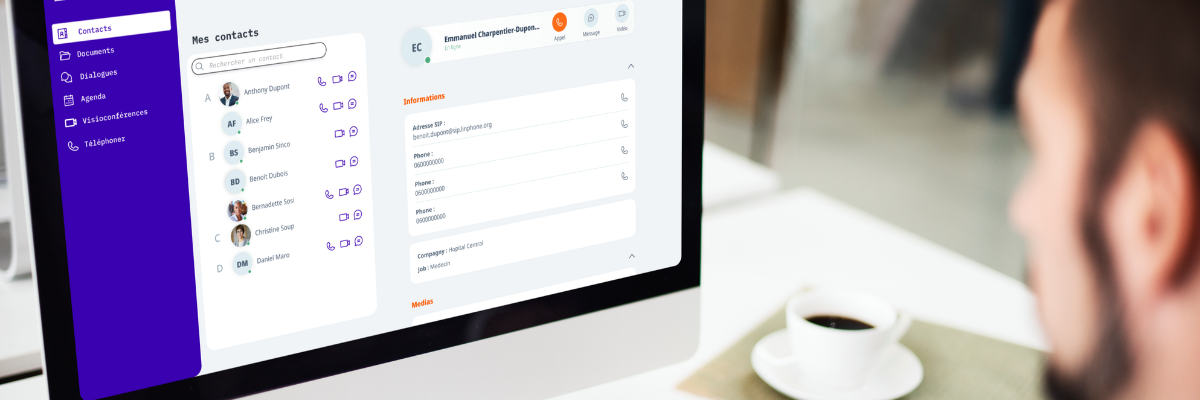
Concretely, calls can be initiated from a directory, a contact card, or a button in the sidebar, without leaving the platform. Call history is centralized, making it easier to track communications, and directories are synchronized across all devices.
Accessible from a computer, a browser, or a smartphone, the solution ensures a simplified user experience, regardless of the entry point.
An Integration Based on Open Standards
Integrating telephony into a Digital Workplace relies on open standards that ensure interoperability and long-term viability. Linphone is based on SIP, WebRTC, LDAP, CardDAV, and OpenID Connect, enabling the use of the same authentication and data management mechanisms as other digital tools.
This approach facilitates seamless interconnection with the existing ecosystem. Telephony can therefore be used directly within tools such as messaging platforms like Zimbra or BlueMind, collaborative platforms like Nextcloud, or communication solutions based on Matrix.
A Unified User Experience
Integrating telephony into the Digital Workplace greatly simplifies user workflows. A typical “click-to-call” scenario illustrates this well: the user logs into the platform, accesses a contact, and initiates a call with a single click.
Everything else – opening the softphone, authentication, retrieving configuration – is fully automated.
From the user’s perspective, the experience boils down to three simple steps:
- Log into the platform
- Find a contact
- Click “Call”
This promotes adoption and reduces the need to switch between multiple tools in daily operations.
An Architecture Designed for Platforms
The Linphone ecosystem is built on a modular architecture designed for easy integration into Digital Workplaces. Clients are available in different forms (desktop applications, mobile apps, and web clients) to suit all use cases. On the server side, Flexisip manages communications, user accounts, and advanced features such as voicemail and call logs.
APIs make it easy to connect telephony with other platform components, particularly for user management or retrieving call data. This architecture enables progressive integration tailored to each organization’s specific needs.
An Approach Adapted to All Use Cases
Within a Digital Workplace, telephony needs vary depending on user profiles. Some users have occasional needs, while others rely on telephony as a core daily tool.
To address this diversity, Linphone offers a combination of web and desktop clients, each with its own advantages:
- Web client (lightweight): Accessible directly from the browser without installation. It is ideal for occasional users or those prioritizing mobility and simplicity. The web client integrates easily into the platform interface and allows users to make or receive calls quickly while maintaining a unified Digital Workplace experience.
- Desktop client (full-featured): A complete application installed on the workstation, suited for advanced use cases. It offers multi-line management, call hold, call transfer, and receptionist features. Thanks to SSO authentication and automatic configuration, users benefit from a smooth, ready-to-use experience with advanced functionality at their fingertips.
This complementarity provides a flexible telephony solution adapted to all user profiles, without compromising between simplicity and feature richness.
Open Source as a Driver of Digital Sovereignty
Linphone, developed by Belledonne Communications, is based on an open source model that ensures transparency, auditability, and full control over data. Organizations avoid vendor lock-in and retain control over their data and infrastructure. They can adapt the solution to their specific needs and freely choose their deployment model or integrator.
In a context dominated by suites such as Microsoft 365 and Microsoft Teams, this approach represents a credible alternative for building sovereign digital environments.
A Truly Complete Digital Workplace
By integrating telephony into the Digital Workplace, the environment becomes fully unified, where all communication and collaboration tools coexist. Telephony is now accessible as a native feature alongside messaging, wikis, and document management tools.
Users can move from a document to a call, then to a business interaction without switching tools. This continuity improves productivity and simplifies daily workflows.
Telephony as a Strategic Lever for the Digital Workplace
Reintegrating telephony into the Digital Workplace with Linphone is not just about modernizing an existing system. It is about redefining the role of communication within the work environment.
By combining telephony, email, and document management within a single platform, organizations gain efficiency. Telephony thus becomes a strategic component of the Digital Workplace, supporting an integrated and sustainable environment.